
Daniel’s Levada Directory
Levada do Caldeirao Verde inferior
Also known as Levada do Caldeirao Verde, Levada das Queimadas, Levada da Serra de São Jorge
Archival documentation — not a current hiking recommendation. Source file on danishome.ch last modified: 2 April 2022
Area
Teixeira/Santana/Northeast
Length
13.3 Km
Course
The Levada do Caldeirao Verde inferior can be divided into 3 sections:
Section 1: From the Madre, somewhat narrow and slippery as far as the descent path from the north-western exit of the Pico Ruivo tunnel; descent path to Chao das Faias (only for very experienced walkers); a bypass of a very narrow levada stretch on a comfortable path; Caldeirao Verde; a very fine passage on a steep rock face; on the valley floor you can make out the stream works of the Levada dos Tornos in Chao das Faias
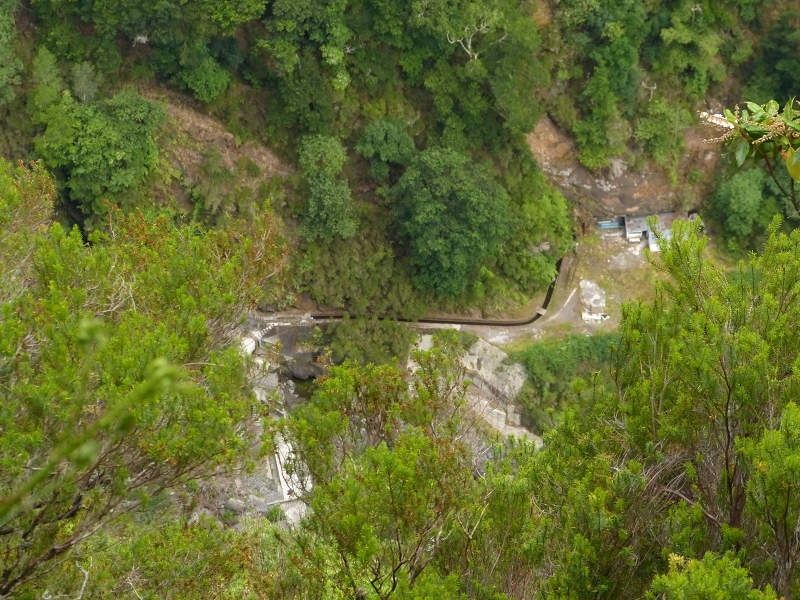
On through 2 tunnels (in places a little low — duck your head!). Just after the second tunnel the levada meets the footpath PR1.1 from Achada da Teixeira to Ilha. Here an alternative path to Ilha (bypassing Vale de Lapa) and the descent to Chao das Faias, to the stream works of the Levada dos Tornos, also branch off (only for practised walkers!).
Section 2: On along a well-built path through an S-shaped tunnel, along a narrow gorge, as far as Queimadas and Pico das Pedras.
Section 3: On horizontally, then descending via Venda Nova and Cova de Roda, and at the end various small branches in the fields
End
Cova do Roda ca. 590 m a.s.l.
Function and use
Irrigation of the Queimadas, Pico das Padres and Cova do Roda area
Access
Section 1:
-
Descent from the north-western exit of the Pico Ruivo tunnel, reached on the
-
Ascent from Chao das Faias on one of the two narrow, dangerous paths
-
Descent from Achada do Teixeira, or ascent from Ilha, on the footpath PR1.1
Section 2:
-
Road from Santana
-
2 gravel tracks from the Levada da Silveira or de Santana
-
Road from Santana via Pico das Pedras to Achada do Teixeira
Section 3:
-
Road and gravel track from Lombo do Galego
-
Road and gravel track from the ER-218
-
Approach from the ER-213
-
Approach from the ER-213
-
Approach from the ER-213
-
Approach from Corujeira de Baixo
-
Approach from the ER-213
Condition
Section 1: moderately difficult, exposed in places, but with intact protection; danger of rockfall on the stretch from the Caldeirao Verde to the Madre
Section 2: wide path, good protection, somewhat exposed around the tunnel
Section 3: wide path, no difficulties
Year built
Once planning of the historic Levada da Serra do Faial became concrete and realistic in 1861, it was clear that the water supply from the Ribeira Seca to the areas above Santana via the Levadinha Joao de Deus would no longer be assured. In 1864 planning therefore began for a water supply from the valley of the Ribeira Grande. In 1875 the project was approved under state direction, construction began in 1877, and in 1904, a year before the historic Levada da Serra do Faial opened, the building work was finished.
It should also be recorded that, already in the 18th century, there were projects to use the water from the valley of the Ribeira Grande for irrigation.
In 1938 a branch was built off the Levada do Caldeirao Verde, ending in a reservoir above Ilha. It runs underground along the path from Ilha to the Levada do Caldeirao Verde inf.; along the footpath you can see surge chambers, or parts of the pipes. You must not take the detour via Vale da Lapa!
Historical notes
The building of the Levada do Caldeirao Verde should be seen as part of a large levada-construction project planned around 1860. Besides the Levada do Caldeirao Verde it also included building the historic Levada da Serra do Faial and closing the Levadinha Joao de Deus, and it was completed in 1905.
Remarks
A very popular levada, with heavy traffic on it; it is worth starting early, so that at least on the way out you can enjoy the quiet.
Starting in Ilha on the footpath PR1.1 is also recommended; it is considerably quieter there!
Although there is a close connection between this levada and the Levada do Caldeirao do Inferno and the Levada do Caldeirao superior, and the two levadas can, so to speak, be walked in a single hike, it has to be said that they are not a functional unit (apart from the feeding of the Madre of the Levada do Caldeirao Verde inf. via a sluice in the Levada do Caldeirao do Inferno, which however was only built 66 years after the Levada do Caldeirao Verde inf.). The Levada do Caldeirao Verde inf. serves to irrigate the areas above Santana; the Levada do Caldeirao do Inferno and the Levada do Caldeirao superior are 66 years younger and serve to supply the Faja da Nogueira power station!