
Daniel’s Levada Directory
Central dos Socorridos
Also known as Kraftwerk dos Socorridos
Archival documentation — not a current hiking recommendation. Source file on danishome.ch last modified: 12 June 2020
Description
The Socorridos power station was built in 1994. The project was meant to meet 3 aims:
-
The drinking-water supply of Funchal and Câmara de Lobos had to be secured
-
Regulation of irrigation around Covão and Câmara de Lobos had to be improved
-
Madeira's electricity production had to be increased with the island's own resources
The Socorridos powerhouse stands on the Ribeira dos Socorridos at 89 metres.
The pressure pipe splits into 4 branches before the generator house.
3 of them drive 3 turbines and 3 generators. The turbines deliver 24 MW, and the energy produced is 40 GWh.
The fourth branch leads to the Santa Quitéria small power station. Here the water is treated and sent on as drinking water for Funchal. Worth noticing is the pipe run climbing the eastern side of the valley, the crossing with the Levada dos Piornais, and the above-ground crossing of a side stream of the Ribeira dos Socorridos on a bridge.
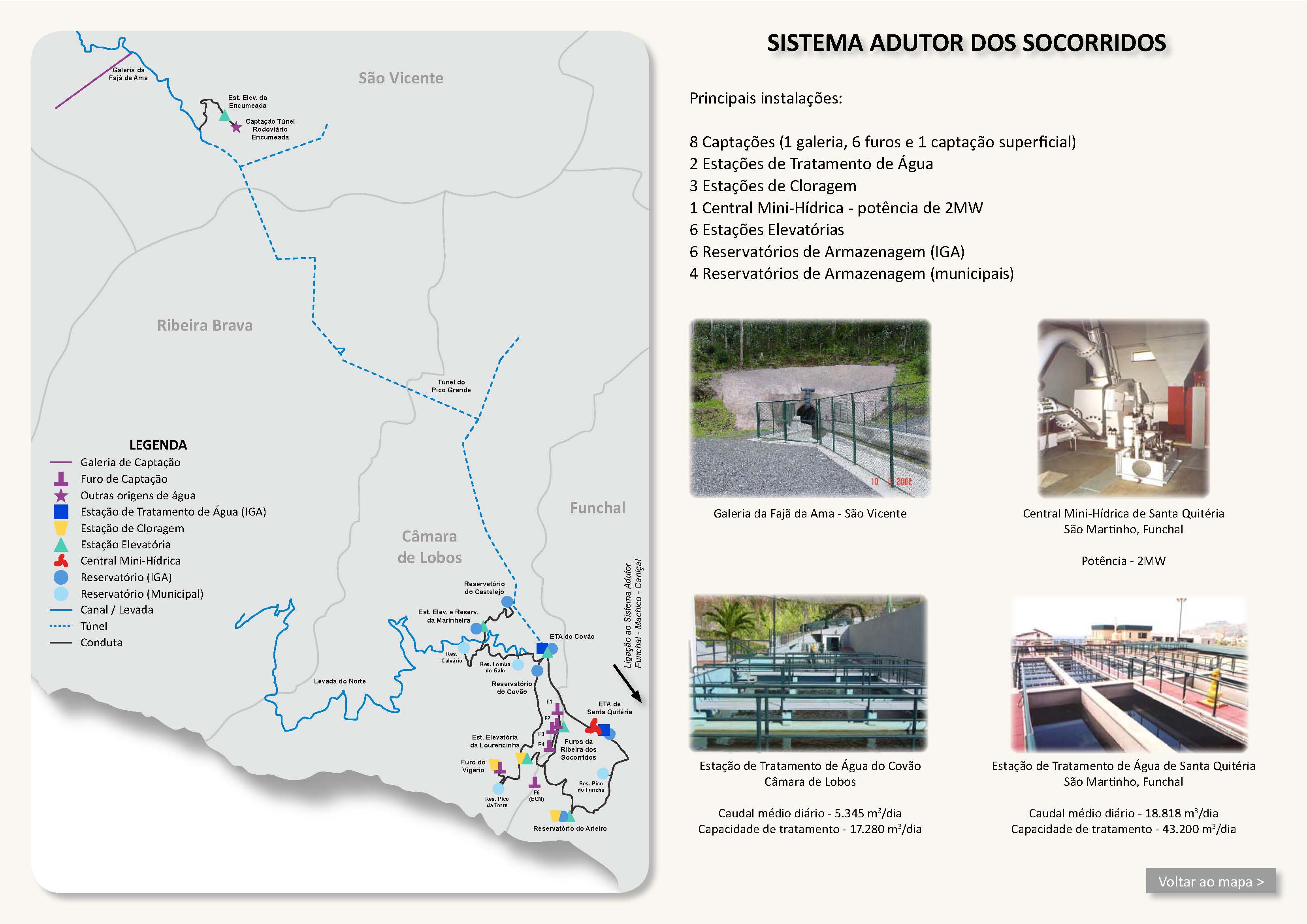
The 1175 m pressure pipe is fed from a forebay at Covão, at 547 metres.
The water reservoirs of Covão and Câmara de Lobos are also supplied from here.
The forebay in turn takes its water from the 4.991 km Tunel dos Socorridos, which runs from Terra Chã to Covão.
Above Terra Chã, on a side stream of the Ribeira do Curral, an underground station was built where 2 feeder tunnels meet. They are the Tunel do Pico Grande and the Tunel da Faja Escura.
The 1.8 km Tunel do Curral das Freiras is collected at Faja Escura, and a storage reservoir of 2'000 m3 is set ahead of it there.
The second tunnel, which ends at Terra Chã, is the Tunel do Pico Grande. It begins in the valley of the Ribeira do Pico, at the point from which the Levada do Norte Süd also flows on. The tunnel is 2.9 km long. The start of the tunnel is in a huge stream-training structure, with storage reservoirs laid out in a complicated way.
From the switching point in the valley of the Ribeira do Pico, the Tunel do Canal do Norte leads to the balancing reservoir of the Serra de Água power station. This tunnel is 2.7 km long and replaces the Levada do Norte Süd on this stretch. At the Ribeira do Poço the tunnel comes briefly to the surface.
The old Levada do Norte Süd between the Serra de Água power station and the switching point is no longer in operation!
The balancing reservoir of the Serra de Água power station is fed on the one hand by water from the generator house and on the other by the Tunel da Encumeada.
This tunnel is 2.8 km long and connects the Levada da Faja do Rodrigues with the Socorridos system.
The original levada was extended with the Galeria Faja da Ama and the Tunel da Ribeira Grande de Sao Vicente.
In this form the power station ran from 1995 to 2006.
The system had 3 drawbacks:
-
After the generator house the water flowed unused into the Ribeira dos Socorridos.
-
The forebay at Covão, at 7'500 m3, was too small and only in winter kept the turbines optimally loaded.
-
Drinking-water supply and irrigation were increasingly in competition with power production.
In summer the water was needed for irrigation and drinking water, and none was left for power production.
Further problems were waiting as well:
-
The wind plants on Paul da Serra produced power steadily across 24 hours, and it was not possible to store the energy produced at night.
-
The hydropower plants likewise produced power steadily, while demand swung sharply through the day.
-
The water needs of Funchal and Câmara de Lobos had to be guaranteed.
-
Water loss in the Levada do Norte Süd, at 1'300 m3 a day, was too high and put at risk the supply for the area between Campanário and Câmara de Lobos.
A project was launched to put these shortcomings right.
It included:
-
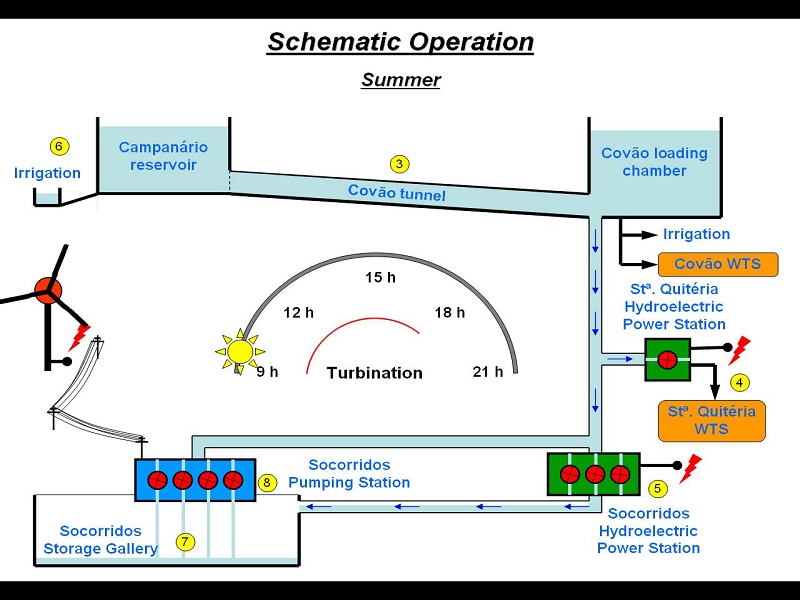
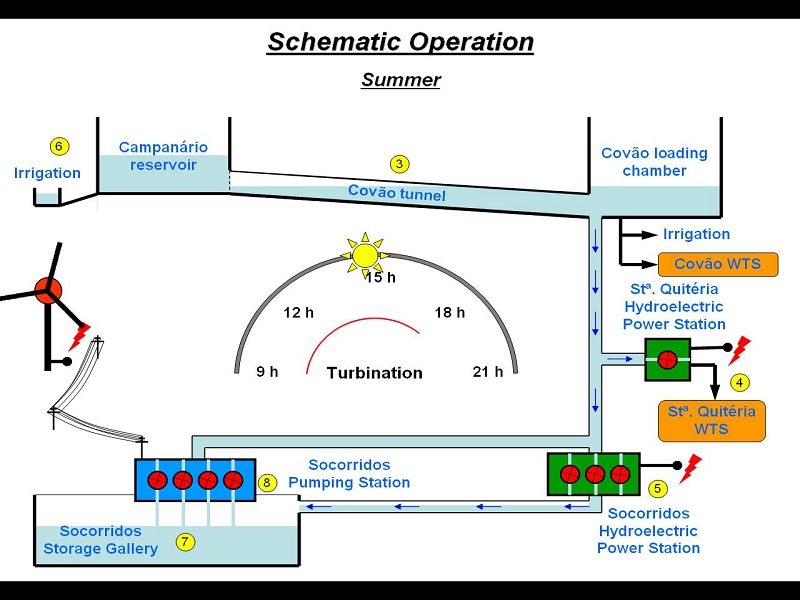
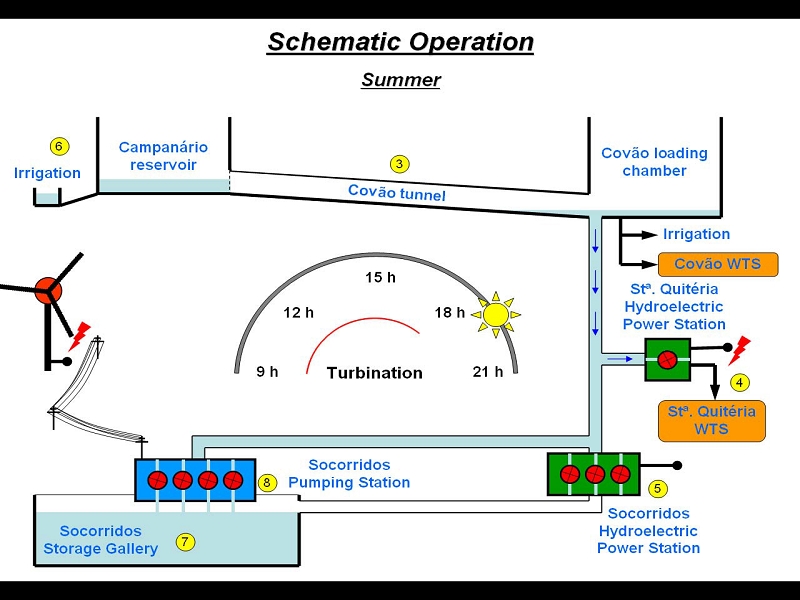
Building a tunnel (3) to store an extra 32'500 m3 of water and to secure the supply between Covão (9) and Campanário (6).
-
Building an underground storage gallery of 40'000 m3 (7) at the Socorridos power station (5), and installing a pumping system (8) from this gallery up to Covão.
-
Enlarging the Encumeada water tunnel (1) and the Canal do Norte tunnel (2) (an extra 55'000 m3 of storage) and fitting gates so that water can be diverted for the supply.
The whole arrangement was meant to work as follows:
The project was planned so that water for power production could be used without being held back by the needs of the water supply.
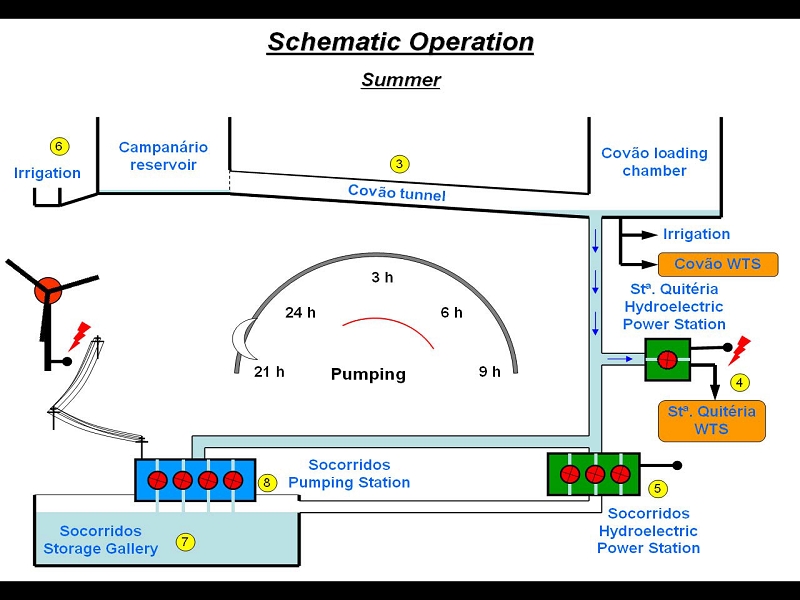
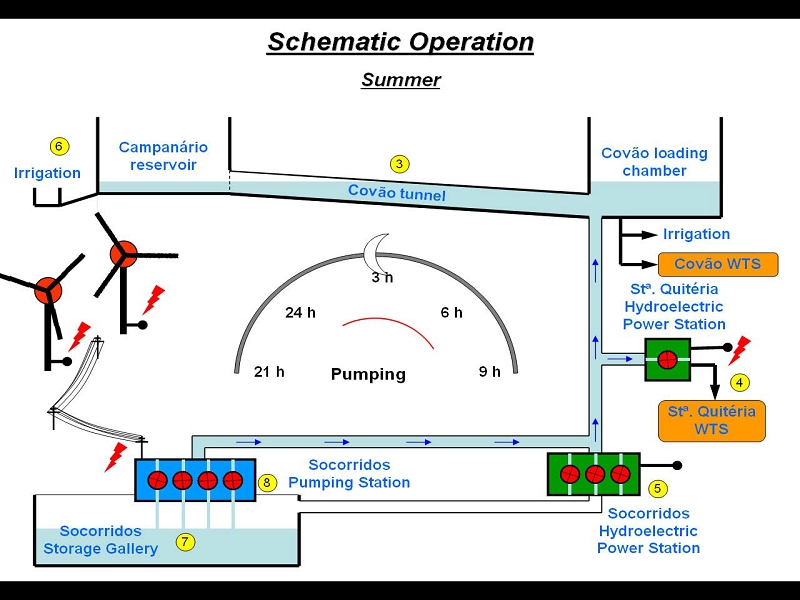
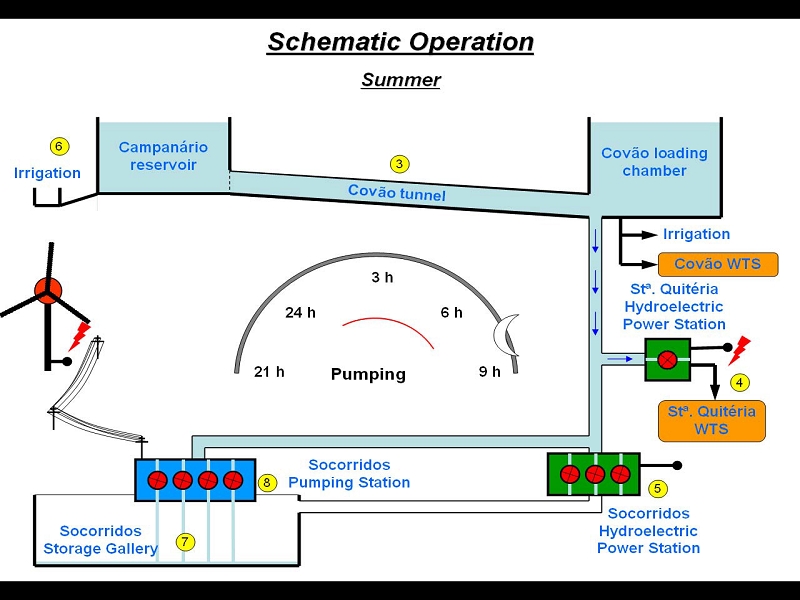
During the day, all the water stored in the tunnels is sent through the turbines at Socorridos and at Sta Quiteria (4).
At Sta Quiteria the water is led into the treatment plant and used on as drinking water for Funchal.
At Covão and Campanário, water can be drawn off for irrigation and as drinking water.
Most of the water goes through the turbines at Socorridos and is then stored in the galleries. At night the water is pumped back up into the Covão tunnel with power from the wind plants, and the water is held in the tunnels.
The loop is closed:
Here is a diagram:
In 2006 the new system was brought into service. The old turbines were kept; the new pumps drive the water up to Covão in the old pressure pipes. Modern storage plants use the same turbines to generate power and to pump.
Further information on the EEM website