
Daniel’s Levada Directory
Levada da Serra do Faial from Lamaceiros/Lombo da Raiz to Pico do Infante
Also known as Levada da Serra do Faial (Lamaceiros / Lombo da Raiz bis Pico do Infante)
Archival documentation — not a current hiking recommendation. Source file on danishome.ch last modified: 24 August 2021
Area
Santo Antonio da Serra - Funchal
Length
24 km
Year built
Planung ab 1861, Bauzeit 1887 bis 1905.
Preliminary note
This levada is part of the historic Levada da Serra do Faial, the lower course of the old levada, so to speak. The levada in its original form has not existed since 1971; since then it is supplied with water by the Levada do Furado, the Levada do Juncal and the Levada dos Accionistas.
The problem of taking and distributing water in this area is very complex. I have tried to pull it together once: Historical development of the Levada da Serra do Faial and the surrounding levadas.
The levada described here is not a levada in its own right. It is, and always was, part of a whole levada structure, the historic Levada da Serra do Faial.
Madrei
Branch of the Levada do Furado N 32°44.350 W 16°50.850 at the water house in Lamaceiros (Caixa Divisoria), into the Levada da Serra do Faial and the Levada da Portela, ca. 830 m a.s.l.
Historically, the correct place for the Madre is actually the Caixa Divisoria at Lombo da Raiz. The section between the Caixa Divisoria of Lamaceiros and Lombo da Raiz really belongs to the Levada do Juncal (see Historical development of the Levada da Serra do Faial and the surrounding levadas)
Lombo da Raiz N 32°44.000 W 16°50450 ca. 829 m a.s.l.
Course
The Levada da Serra do Faial can be divided into 4 sections:
Section 1: From the water house in Lamaceiros at the end of the Levada do Furado, or from the Caixa Divisoria of Lombo da Raiz, towards Santo Antonio da Serra. Two branches of the Levada da Serra, the first of which already begins at the Caixa Divisoria of Lombo da Raiz, more or less parallel to a gravel track through woodland along an open levada as far as Quatro Estradas. In 2019 the water was diverted into the Ribeira Primeira; after that the levada bed is destroyed and dry. The water diverted here may be taken in again further down the ribeira; the stream bed where it crosses the ER 110 has at any rate been neatly built up.
Section 2: From Quatro Estradas it is piped, a pleasant walking path, crossing the Levada da Morena, a short tunnel, an old levada bridge, crossing the Levada do Pico das Eiroses. From here water flows again, branched off from the Levada do Pico das Eiroses. A pleasant levada section with an old levada bridge. After that nothing more can be seen of the levada; in its place a road runs above Eiras do Dentro as far as Rochao, and an inaccessible tunnel that is not possible to walk.
Section 3: Rochao, the end of the tunnel, open again as far as Camacha with little water, crossing the Levada do Pico do Arvoredo, alternating stretches of road and a pleasant walking path along the mostly dry levada as far as the ER-203
Section 4: After the ER-203 through woodland, the levada mostly dry, crossing the Levada do Blandy, a last water outlet, and then only a walking path as far as Choupana and the Caminho Meio
End
Choupana ca. 680 m a.s.l.
Function and use
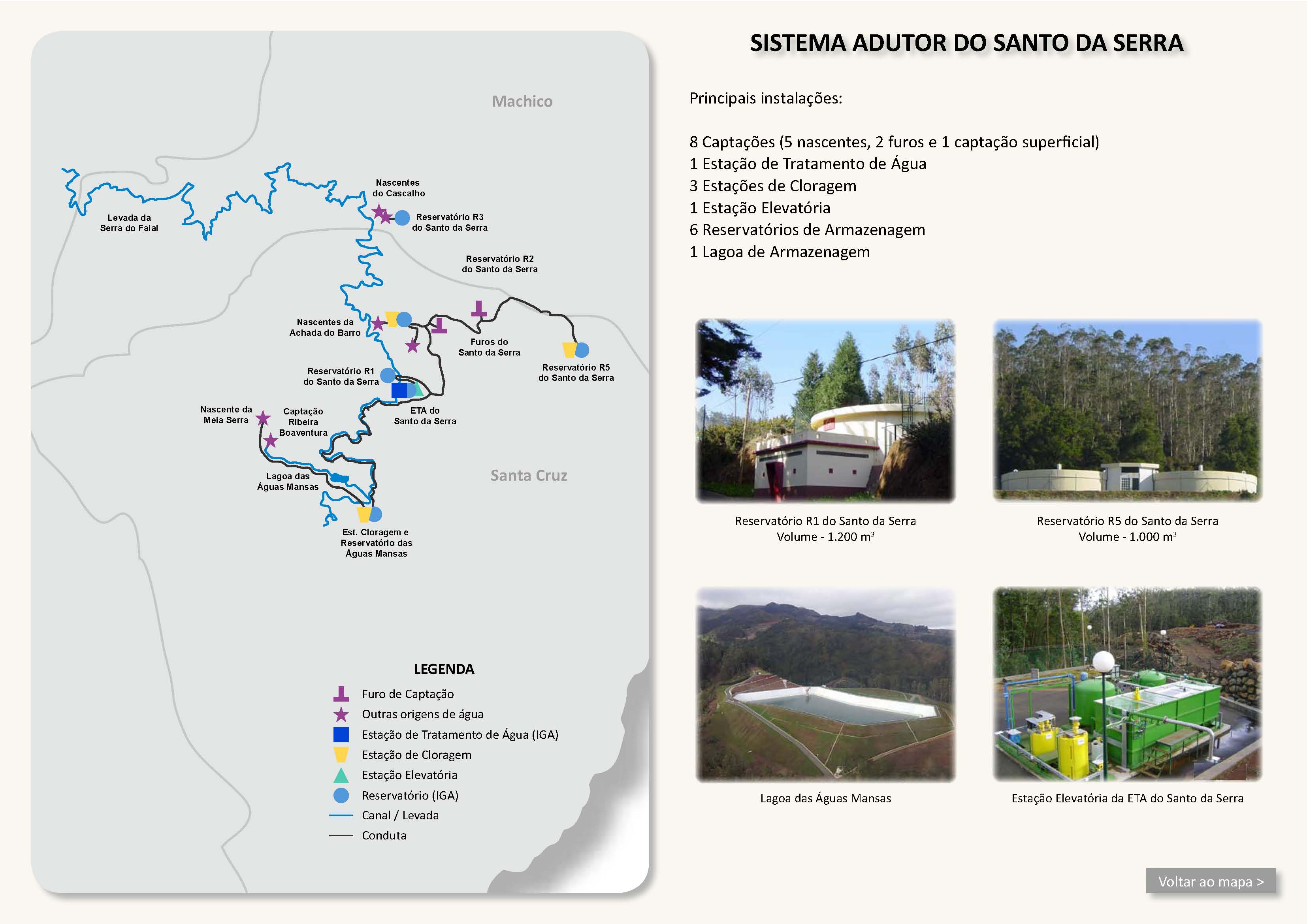
Formerly irrigation of the east coast as far as Funchal; today only partly still in use, or piped. In 2010 it was decided to bring the Levada da Serra do Faial partly back into service. See the newspaper report. The water from the Levada do Furado that is branched into the Levada da Serra do Faial is led in the old levada bed as far as Quatro Estradas and collected there in the Reservatorio R1 do Santo da Serra.
This is connected by pipelines to the Lagoa das Aguas Mansas (fed by the Levada do Pico das Eiroses) and to the Reservatorio R5 do Santo da Serra (pumping station in Quatro Estrades). See the water supply of the Santo da Serra area
Access
-
Lombo das Faias on the ER-102. Past the snack bar!
-
Via the northern branch of the Levada da Serra from the ER-102, either by the road or along the old piped passage before the roundabout ca. 1.5 km
-
Via the southern branch of the Levada da Serra from the ER-102
-
Via the gravel track from the ER-102
-
Via the gravel track from the ER-202
-
Via the gravel track from the ER-102
-
Via the crossing with the ER-202 in Quatro Estradas
-
Ascent from the ER-102 via the Levada da Morena
Ascent from Aguas Mansas via the gravel track to the Lagoa das Aguas Mansas or the Levada do Pico das Eiroses
-
Via the gravel track from the ER-102
-
From the ER-102, the turning by the filling station above Eiras do Dentro
-
From the ER-102, the road to Rochao
-
From Camacha, the road to Igreja
-
From Camacha (Rua Maria Ascension), the road to Achadinha
-
From Camacha (Rua Maria Ascension), the road to Achadinha or straight to the levada.
-
From the ER102 in Valparaizzo
-
Crossing with the ER-203
-
From the ER-102, the straight path
-
To the upper end via the ER-201 or the ER201: walk up on foot from the Botanical Garden, steep and unattractive, or park in Choupana (ER-201)
-
To the lower end via the ER201
Condition
Since the Levada dos Tornos was built in 1966, the watercourse from Quatro Estradas to Choupana has been largely dry. The bed of the levada has been removed in places. The path, though, is easy to walk throughout, even if it is not equally attractive everywhere!
Section 1: In places with an open levada, attractive country; from the Ribeira Primeira a decaying levada bed and a silted-up track
Section 2: Levada piped, attractive as far as Ribeiro Serrao, the rest as far as Rochao running under the road
Section 3: Above the residential areas of Camacha, in places surprisingly away from civilisation
Section 4: Levada at first mostly dry, then barely recognisable; quite recommendable as a walking path
Remarks
In places one can see the effort to keep the levada in repair, but it is clear that it has lost much of its former importance.