
Daniel’s Levada Directory
Levada do Norte Nord
Also known as Levada Grande (oder Norte Nord)
Archival documentation — not a current hiking recommendation. Source file on danishome.ch last modified: 19 July 2025
Area
Northern slope of the Paul da Serra/northwest
Length
ca. 13,7 Km
Year built
1953
Madrei
Ribeira da Hortela N 32°46.950 W 17°06.250 ca. 1025 m a.s.l.
Course
The Levada do Norte Nord can be divided into 3 sections:
Section 1: From the Madre in the Ribeira da Hortela, first over narrow balconies, then to the crossing of the Corrego da Beira do Lombo Queimado, a longer tunnel, a short passage of the southern branch of the Ribeira do Folhado, a narrow tunnel with slabs laid across the middle, a short passage of the northern branch of the Ribeira do Folhado, a tunnel and the passage of the Ribeira do Vimieiro. Shortly after, the path that comes from the Paul da Serra over the Lombo das Barbinhas meets the levada. On the descent to the Levada do Seixal the Ribeira do Vimieiro has to be crossed in a stream passage that is awkward depending on the weather, and the Madre of the Levada do Seixal also lies on this stream.
The descent to the Levada do Seixal comes next, then on along a broad path and another stream crossing to the first levada house
Section 2: From the levada house, first on a broad levada path with a wet stream crossing, passage of the great gorge of the Ribeira do Agua do Vento on an exposed, wet path of slabs with protection that is partly destroyed, very wet, a small water tunnel as a further inflow, a levada bridge and an inflowing levada from an impressive little gorge. Before the tunnel entrance, steps can be seen in the rock on the left for the climb to Terra Cha (described by a walking group). The first long Terra Cha tunnel (about 1.3 km) to the northernmost point of the levada. Right at the tunnel exit, on the left, a steep, exposed path leads up to small feeder levadas, with the chance of climbing to Terra Cha. Here you are at the crossing of the Ribeira de Joao Delgado.
A short section about 30 metres to the east, 2 small feeder levadas from above, and the 2nd long tunnel (about 1.3 km) into the valley of the Ribeira do Inferno, then a longer section in the open as far as the crossing of the western arm of the western main branch of the Ribeira do Inferno and the crossing of the eastern arm of the western main branch of the Ribeira do Inferno. After that, about 450 m of tunnel to the crossing of the eastern main branch of the Ribeira do Inferno. At the tunnel exit, on the left, a chance to climb to a small feeder levada and on to the Levada do Plaino Velho. A short, winding section in the open and the 4th long tunnel (about 600 metres) to the crossing of the western main branch of the Ribeira do Passo. Right at the tunnel exit, a way up and a way down to the Vereda Pau Branco, which runs from the Levada do Plaino Velho to the Levada da Faja do Rodrigues. On in the open and through a short tunnel to the crossing of the western main branch of the Ribeira do Passo. Protection left by the canyoning people can be seen here.
The 5th long tunnel (about 500 metres) to the crossing of the western main branch of the Ribeira dos Pombos. A medium tunnel to the crossing of the eastern main branch of the Ribeira dos Pombos, 2 further shorter tunnels, and then first a path up to the right to the first levada house, and a few metres more to the gravel track from Ginjas to Estanquinhos.
Section 3: From the gravel track, past the second levada house, a broad levada path with 3 crossings of side branches of the Ribeira Seca, becoming somewhat exposed, a shorter winding tunnel, crossing of the western main branch of the Ribeira Seca, a longer tunnel (just under 400 metres) to the next crossing of the eastern main branch of the Ribeira Seca (this is also crossed by the Levada da Faja do Rodrigues in a large stream-training structure). Immediately the next tunnel (a good 400 metres). After a few metres the PR-17 goes down to the left over a few wooden steps; a longer course in the open, with the crossing of the western arm of the western main branch of the Ribeira da Vargem. Here an inflowing levada leaves to the south-west, beginning in a waterfall worth seeing. A long tunnel (a good 800 metres) to the Folhadal waterfall and the crossing of the western arm of the eastern main branch of the Ribeira da Vargem. Here the Amigos da Natureza have also already dropped down, and other walking groups have climbed up to the Pinaculo. On, well protected and on a broad path, through the Folhadal, with 3 crossings of side branches of the Ribeira do Vargem. This is also taken by the Levada da Faja do Rodrigues in the large stream-training structure before the tunnel to the Serra de Agua power station. A last tunnel (just under 600 metres) to the confluence with the Levada das Rabacas, forming the Canal do Norte.
End
Canal do Norte ca. 993 m a.s.l.
Function and use
Inflow to the Serra de Agua power station
Access
Section 1:
Condition
Section 1: This section is relatively wet and slippery, has little protection, and is very lonely! Watch out! Exposed in places. The last metres to the Madre are very wet and quite dangerous!
Section 2: The path is little walked, relatively long, and studded with several long tunnels ("big tunnel-rat diploma"). The sections between the tunnels are unique and imposing (waterfalls, bridges, views). The tunnels are mostly quite good to walk, the paths relatively well protected, but in places badly exposed! The great gorge at the crossing of the Ribeira do Agua do Vento is especially awkward.
Section 3: The part from the Encumeada pass to the Folhadal tunnel is straightforward; the first tunnel is just under 600 m long and relatively broad. As far as the Folhadal the path is easy, the nature is unique, a stark contrast with the Encumeada side.
At the waterfall a second tunnel follows, clearly longer and narrower. The path stays easy. After a few minutes a stair path branches off to the right (the official, new PR-17), which after the descent runs straight on for about 15 minutes (finding the way is no problem; just stay on the path), then quite steeply up about 800 (!) steps to a beautiful viewpoint, then an easier descent and ascent, and you meet the Levada do Plaino Velho (no water!). This leads to the gravel track from Ginjas to the Casa Caramujo (about 30 minutes).
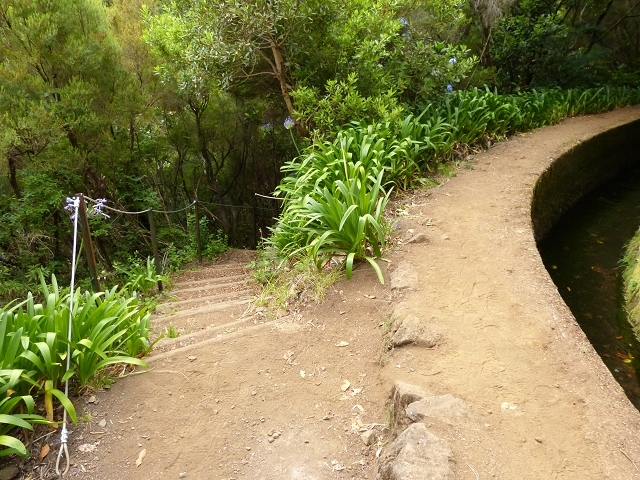
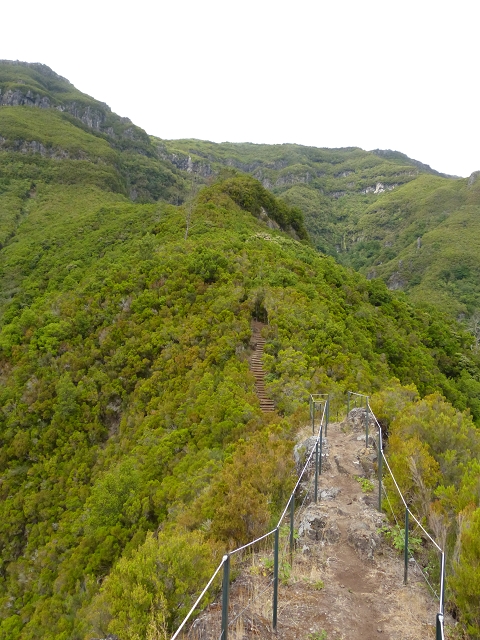
Note the difference between the route on the ground and the description of the PR-17 on the tourism website www.visitmadeira.pt. The course and the tunnels of the Levada do Norte are drawn incorrectly there as well! On this you continue on the Levada do Norte through 3 tunnels to the second levada house (Walk 2013).
This section is lonely and has a few places without protection, but it is relatively easy to walk ("little tunnel-rat diploma").
From here the gravel track leads down to Ginjas, past the Levada da Faja do Rodrigues, or up to the Casa Caramujo and on to Estanquinhos, and on the way it meets the Levada do Plaino Velho. There you can follow the PR-17 again in either direction.
Remarks
I consider the Levada do Norte the most compelling levada on Madeira, both for the landscape and for the walk itself. Demanding, and full of variety.
What is compelling about the Levada do Norte are the little trodden paths where the long tunnels come out to the surface. They usually lead straight up, quite exposed, and meet small feeder levadas that supply the main levada with water. In most cases the paths then continue further as well.
Examples:
-
Tunnel exit at the crossing of the eastern branch of the Ribeira do Inferno, climb to the Levada do Plaino Velho (see Walk 2015)
-
Tunnel exit at the northernmost window of the Levada do Norte below Terra Cha, climb to Terra Cha (see Walk 2015)
-
Tunnel exit at the crossing of the Ribeira do Passo, climb to the Levada do Plaino Velho (see Walk 2015) and descent to the Levada da Faja do Rodrigues (see Walk 2015).
Unfortunately the walk on the north side depends heavily on the weather; it is best to pick a day when the wind is not from the north-east!